Bead · darts game rules
501 darts rules (301, 701 and 1001)
X01, 301, 701, 1001
501 is the game you see on television and in almost every darts league. Each player starts with the same score and counts down to exactly zero. The shorter 301 is great for quick games or new players, while 701 and 1001 suit teams and long matches. The rules are simple, but finishing cleanly on a double is where games are won and lost.
- Players
- 1 to 8 (solo friendly)
- Length
- ≈ 20 min
- Difficulty
- Demanding
- What you need
- A dartboard (steel tip or soft tip) and 3 darts per player.

Rules
Setup
- Choose a starting score: 301, 501, 701 or 1001.
- Decide how players must finish: Double Out (the standard rule) or Straight Out, where any segment can finish the game.
- Agree on the throwing order. Players take turns, three darts each.
How to play
- Throw three darts and add up the total of the visit.
- Subtract that total from your remaining score.
- Keep taking turns until someone reaches exactly zero.
- With Double Out, the final dart must land in a double or the inner bull (50).
Scoring
- A single scores the number hit, the outer ring doubles it and the inner ring trebles it.
- The outer bull is worth 25 and the inner bull (bullseye) is worth 50.
- The highest possible visit is 180: three treble 20s.
- Bust: if a visit takes you below zero, your score goes back to what it was before the visit. Under Double Out, leaving yourself on 1 or reaching zero without a double is also a bust.
Winning
The first player to reach exactly zero wins the leg. The highest possible finish is 170 (treble 20, treble 20, bullseye), and a perfect 501 takes nine darts.
Tips
- Aim for treble 20 to score heavily. If your darts drift left, treble 19 is a popular backup.
- Try to leave an even number that halves nicely, such as 32 (double 16) or 40 (double 20). If you miss into the single, you still have a double left.
- Learn a few common finishes: 100 is treble 20 then double 20, 60 is single 20 then double 20.
- Some scores cannot be finished in three darts: 169, 168, 166, 165, 163, 162 and 159. Avoid leaving them.
Variants
- Double In: a player's score only starts counting once they hit a double.
- Sets and legs: play several legs to win a set, and several sets to win the match, like professional matches.
Checkouts worth knowing (double out)
| Left | Finish |
|---|---|
| 170 | Treble 20, treble 20, bull (50) |
| 167 | Treble 20, treble 19, bull |
| 164 | Treble 20, treble 18, bull |
| 161 | Treble 20, treble 17, bull |
| 160 | Treble 20, treble 20, double 20 |
| 141 | Treble 20, treble 19, double 12 |
| 121 | Treble 20, treble 11, double 14 |
| 110 | Treble 20, bull |
| 100 | Treble 20, double 20 |
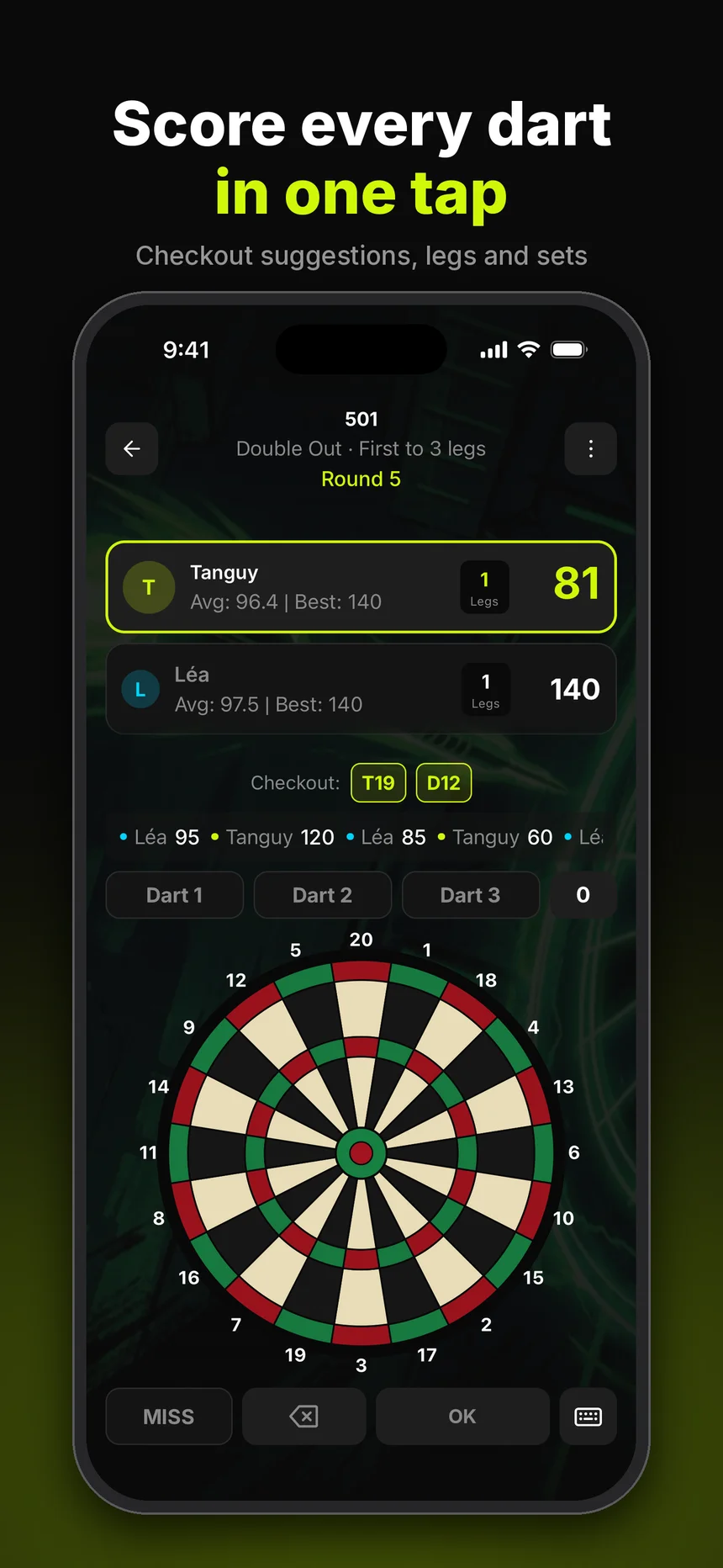
| 81 | Treble 19, double 12 |
| 60 | Single 20, double 20 |
| 40 | Double 20 |
| 32 | Double 16 |
No three-dart finish exists for 169, 168, 166, 165, 163, 162 and 159.
FAQ
- What does double out mean in 501?
- The dart that takes your score to zero must land in a double or the bullseye (50). Otherwise the visit is a bust and your score goes back to what it was before.
- What happens when you bust?
- If a visit takes you below zero, leaves you on 1, or reaches zero without a double under double out, it does not count: your score resets to its value before the visit and play moves on.
- What is the highest checkout in 501?
- 170: treble 20, treble 20 and bullseye, known as the big fish. A perfect leg of 501 takes nine darts, for example 180, 180 and a 141 finish.
- What is the difference between 301 and 501?
- Only the starting score. 301 is shorter and often played double in in American leagues; 501 double out is the standard format in competition.